
Shape of Dreams Mist Guide: Builds, Combos and Boss Timing
Use Lunge for focused single-target bursts, or Flèche for mobile wave clearing once you unlock it. Mist is a starting melee attacker whose best openings come from controlled movement: weave basic attacks between skills, deal your burst, then leave before enemies retaliate.
Her mobility gives you more ways to enter and escape a fight. It does not make standing beside a boss safe, especially on Nightmare. Build enough damage to use the opening, then protect the next one with cooldown support, health, and Barriers.
Choose Lunge or Flèche
| Main Memory | Best use | Starting package |
|---|---|---|
| Lunge | Focused boss damage and deliberate directional movement, particularly in solo play. | Focused Strike with Priorité for damage; En Garde is a more forgiving practice choice. |
| Flèche | Clearing groups, reaching dangerous targets, and repositioning through a fight. | Lightning Breath, Coup de Grace, and En Garde for mobile damage and Barrier support. |
Defeat 75 Elementals to unlock Flèche. Until then, Lunge is a usable main Memory in its own right. You do not need to wait for the alternate skill to start learning Mist's attack timing.
Lunge has a six-second base cooldown under v1.4. It fits an Attack Damage build well, and Focused Strike strengthens its single-target purpose. Priorité also scales with Attack Damage, but if that alternate Identity Memory is still locked, use En Garde while you work toward its in-game requirement.
Priorité's v1.4 version has no cooldown, deals 45% Attack Damage as its base damage, and grants 10% movement speed plus 5% per level. There is no reason to spend toward an old Priorité cooldown target with this version.
Flèche offers three charges and resets your basic attack between uses. Lightning Breath and Coup de Grace support its damage and clearing, while En Garde provides protection when you teleport into the pack. En Garde's Barrier scales with Ability Power, so AP and maximum health are useful investments when this Flèche route needs more survival. Attack Damage still supports AD-scaled damage Essences such as Void; choose between damage and protection according to what is holding the run back. The Barrier gives you room for mistakes, but you still need a way out.
Learn the damage window before chasing equipment
Lunge: attack, dash, attack
Start with basic attack → Lunge → basic attack. Lunge resets your attack, so the second basic attack can follow without waiting through the normal gap. Aim diagonally across an incoming attack where possible, rather than directly toward its center.
Against a boss, wait until it commits to an attack and you have avoided the danger. A longer opening can allow Lunge → basic attack → Parry → basic attack → Lunge, but only continue if the Memories are ready and the boss gives you enough time. Leave early when the next attack is starting; completing the sequence is less important than keeping an escape available.
You can also use Lunge as an extra dodge. Giving up a damage cast to avoid a dangerous hit often preserves more of the run than forcing one more attack.
Flèche: space the charges and choose the landing point
Use basic attacks between Flèche charges when it is safe. Spending all three instantly wastes some of the attack resets, especially early in a run when those basic attacks are a useful part of your damage.
Aim toward an enemy at the back of a pack to position Coup de Grace's area burst. When a group is chasing you, moving away first can pull it together for a cleaner clear. If you become surrounded, a separate weak target can give you a teleport destination that creates distance from the larger group.
Keep Parry or a dodge ready for the threat that comes after your burst. Do not put Paranoia on Lunge or Flèche: an automatic movement cast can send you into a boss attack when you intended to stay away. If you want automation, place it on a suitable defensive Memory such as Ice Shield or Mass Protection instead.
Build damage and cooldown together
A useful starting rule is one cooldown Essence and two damage choices on your main Memory. Adjust it to what you find rather than waiting for a rare ideal setup.
| Need | Useful options | What to watch |
|---|---|---|
| More casts while attacking | Momentum | Supports the repeated attacks in your combat loop. |
| Cooldown reduction from Light hits | Flow | Works with Flèche's Light damage. |
| Faster resets while clearing | Metal | Depends on kills; do not rely on it alone against a boss with no extra enemies. |
| More area damage on casts | Void | Adds an Attack Damage-scaled effect that benefits both routes. |
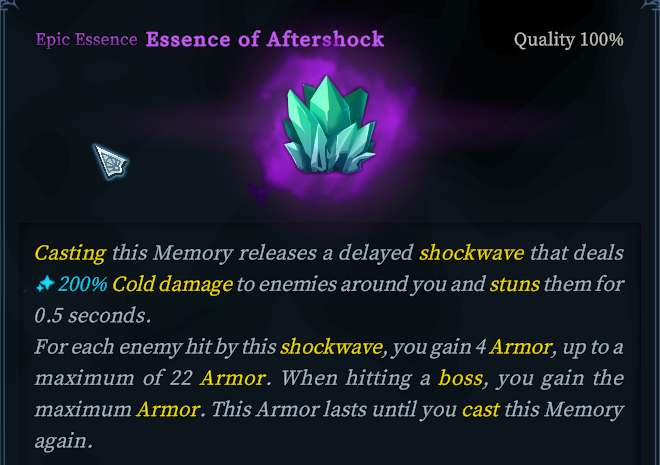
| Area control and armor | Aftershock | Adds a delayed shockwave, a brief stun, and armor after hitting enemies. |
For Lunge, look for Attack Damage-scaled options such as Void, Lethality, or Confidence. Add Pain when groups are the part of the run you cannot handle. Flèche benefits from repeated-cast and on-hit effects, and often gains more from better clearing damage than from filling every slot with cooldown reduction.
Aftershock is especially useful when you want one slot to provide area damage and protection. At 100% quality, its tooltip gives a delayed 200% Ability Power Cold-damage shockwave that stuns for 0.5 seconds. Each enemy hit grants four armor, up to 22; hitting a boss grants the maximum. That armor lasts until you cast the attached Memory again.
Put additional survival tools on another Memory so that your main damage slots can keep doing their job. Ice Shield, Mass Protection, and Frostbite are useful options. Umbral Edge and Arrow Storm add attack effects, while Swift Slash, Teal Blade, and Flaming Whip can bridge early damage gaps.
Favor Memories you can use without breaking your movement plan. A powerful cast that leaves you stationary in danger can cost more health than its extra damage saves.
Spend for survival as the run gets harder
In the first two worlds, take useful common Essences and keep moving. You do not need a legendary drop to make progress. Wait for a safe Memory opening instead of forcing every possible basic attack while enemies surround you.
Around +7 on your main skill, reassess where the next Dream Dust upgrade helps most. That is a practical checkpoint for improving useful Essences instead of automatically buying more Memory levels, rather than a universal stopping rule.
For a Lunge setup, Focused Strike is the main single-target Star choice. Avoid pairing it with Cutting Through Wind in this setup, since that combination can cancel the selected Focused Strike benefit. Charged Saber adds a guaranteed critical Parry and a Barrier, while Wide Vision makes its coverage more forgiving. Strength Enhancement supplies early Attack Damage, Light as a Feather helps with kiting, and Steel Refinement or Second Wind can give you room to recover from a mistake.
For Flèche in co-op, Monstrous Charm, merchant refreshes, and dust or gold bonuses help the team find useful pieces. Your mobility is also valuable for reaching dangerous ranged enemies before they pressure your allies. Use short control effects to open space for the group, rather than teleporting into every available target.
In solo play, place more weight on your own reliable damage and survival. Nightmare reduces sustain, and extra Lucid Dream modifiers add pressure beyond the base difficulty. When a boss already dies quickly, more health, recovery, or Barrier support is often worth more than a small reduction in kill time.
Use these boss openings
These are useful starting patterns for timing Mist's bursts. From Ominous Dream upward, v1.4 adds harder patterns to some Heroic world bosses, so react to the attack in front of you instead of treating the fight as a fixed script.
Belphomet
Circle at a safe distance and look for the opening after his usual pair of swings. Move in for a short burst, then get out before the next attack. You do not need to stay in basic-attack range throughout the fight.
During the orb phase, watch the alternating up-and-down waves. The base pattern uses five waves; enter after the final wave instead of teleporting into the volley. Keep Lunge available as an extra escape, and use Parry when a missed dodge would otherwise leave you exposed.
Seeker
Wait for the opening green energy ball before committing Flèche. If your position and timing allow it, Parry the projectile first, then attack. This also clears space for teammates who would otherwise have to work around it.
Save a dash or Parry for the meteor and its possible follow-up. Circle while it is being cast and resist spending your last escape merely to fit another hit.
When Seeker disappears, prepare for the reappearance rather than chasing blindly. Parry and a short Flèche burst can fit the return window. If Parry is unavailable, hit only while you can still dash through and away from the next threat.
Dark Moon
Save Parry for sudden dashes and the dangerous phase transition with multiple swords. Her longer gaps can allow a three-charge Flèche burst, but watch the next telegraph and stop attacking as the opening closes.
Prepare your defense before the transition. Having damage ready is useful; having Parry available when several attacks arrive together is what lets you keep using it.
Fix the reason the run is failing
| Problem | Change to make |
|---|---|
| You die as soon as you enter a fight. | Remove movement automation, wait for the enemy attack, and preserve an exit charge. |
| Lunge kills bosses but struggles with groups. | Add area effects such as Void or Pain, or use Flèche when unlocked. |
| Clearing is comfortable but boss casts stall. | Use an on-hit or Light-damage cooldown option instead of depending only on kill resets. |
| One small mistake ends the run. | Add maximum health, a Barrier source, and a defensive support Memory before another damage effect. |
Mist rewards choosing when to commit. A shorter burst that leaves you ready to escape is better than an extra attack that strands you beside the boss.